While displacement is still ongoing, and food is still hard to access; our response is still taking place to fulfil our obligation towards the most vulnerable people in Syria.
Stand with us and get involved.
As the continued displacement waves from the eastern Ghouta and neighborhood of Al-Kadam in Damascus is still arriving to the northern Syria, the emergency response teams continue to work to receive these waves of displacement. Where the number exceeded 29 thousand displaced in March alone.
IhsanRD, in collaboration with a number of “Syrian NGO Alliance” members, is coordinating the response to the new IDPs within Idlib governorate. During March, the waves of displacement have been received one after the other at the reception point – Point 0- then transporting the displaced families to temporary shelters before heading to their new residence in the north of Syria.
IhsanRD’s and other humanitarian organizations’ teams are working on the ground to provide the basic needs to the displaced people such as drinking water, hygiene kits, dignity kits, blankets and children’s clothing, within “0 Point” and in temporary shelters. IhsanRD’s emergency response team also, builds toilets and maintains cleanliness at the reception point, as well as providing continuous water.
“Waseem” the Coordinator of Emergency Response at IhsanRD, spoke of the efforts being made by saying:
“The emergency response teams in the field continues the night by day to provide basic services to new IDPs who have been still flowing continuously and in large numbers.” IhsanRD and a large number of humanitarian organizations are doing their best to alleviate the suffering of our displaced people, and there is great cooperation and coordination at the highest levels among the Syrian organizations, but there are too many needs to provide and we must act quickly, especially as Ramadan approaches “.
IhsanRD’s response comes with the support of the United Nations International Emergency Fund for Children (UNICEF), where a joint project to support new displaced persons in northern Syria was signed a recently through many projects like trucking water to the camps and rehabilitate a number of water plants in the north of Syria. The project also includes the distribution of 48.000 hygiene kits, 18.000 blankets, 10.000 clothes basket, 25.000 water plastic bottles, 9.000 plastic cover and 4000 dignity kits. In addition to the construction and rehabilitation of water courses in reception centers for displaced persons and in camps.
[widgets_on_pages id=”widget demo”]
In a country that used to be bombed by warplanes every day, it was imperative for all people -young children and adults- to learn the fundamentals of dealing with disasters and training on security and safety measures that could be the difference between life and death at any moment.
Through its projects, IhsanRD seeks to save the lives and keep safety of both staff and beneficiaries, by taking the necessary measures to mitigate the risks and carry out periodic safety and security training.
Education Department at IhsanRD, in collaboration with the Syrian Civil Defense developed a safety and security plan, in addition to an evacuation plan in the schools supported by Ihsan Relief and Development in the western Aleppo countryside. Then a specialized trainer from the civil defense “White Helmets” has conducted the necessary training for both teaching staff and students to implement the safety and security plan properly.
The training included the evacuation plan in case schools are at risk, how to use fire extinguishers and ways to extinguish various fires. As well as the distribution of brochures describing the methods of shelter during the bombing and brochures about the remnants of the war of unexploded ordnance.
The trainings were held in 5 schools in the western Aleppo countryside, with 120 teachers and 3450 students.
In addition to safety and security training, IhsanRD provides its schools with safety equipment and fire extinguishers and check them periodically to ensure their effectiveness.
[widgets_on_pages id=”widget demo”]
During the war years in Syria, displaced people have been suffering from lack of drinking water in the camps, which has directly affected their daily lives. Some of what we take for granted may be considered as a daily struggle for thousands of Syrian families in camps.
In some camps, the only way to get potable water to survive is through Water Trucks from faraway places, especially as most water stations are out of service as a result of war and continuous shelling.
The drought and the scarcity of drinking water have led to many serious problems facing IDP communities in Idlib. The lack of rangeland and drinking water has had a negative impact on livestock and crops, threatening the food security to people and increasing child malnutrition rates.
Through the Water Program and in cooperation with UNICEF & Ihsan Relief and Development (IhsanRD) has launched a new project responding to the needs of IDP families in Idlib, Hama and Aleppo Western countryside by providing them with daily drinking water tanks for 10,000 families of water Up to 1250 m3 per day. In addition, the project team has rehabilitated two water stations in Sraqib and Bennin and supplied them with the necessary fuel for work.
“As long as the water trucks continue to come, we can endure, but if we are cut off for a week, the situation will become catastrophic and we will have to move elsewhere. As you can see, displacement is not only about the security situation but also about the availability of reasons for living,” said Abu Yahya, head of his household (a wife and three children).
Eng. Mohammed project officer in within Water Program at IhsanRD said:
“Providing water to the camps is essential for the lives of people who are living in the most difficult conditions, not only for drinking, but water also is necessary to improve hygiene, particularly in the circumstances of displacement.”
In addition to providing water to beneficiaries in different ways, the project also includes a number of activities aimed at improving the hygiene of IDP families in both camps and displacement communities through the distribution of garbage containers, sewage drainage in camps and construction of toilets, collecting garbage from camps by trucks and unloading them in dedicated dumps away from the camps in order to improve hygiene in displacement communities.
In addition, the project team distributed granules to sterilize the water to the families within the camps. In the coming phase, water tanks will be installed, clothes and blankets will be distributed in many camps in the countryside of Idlib and Damascus countryside.
[widgets_on_pages id=”widget demo”]
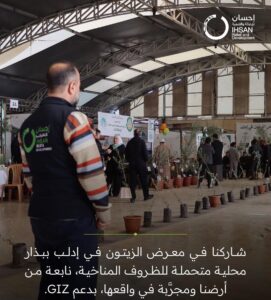
In Syria, every season the farmer relies on his land for living. However, harsh conditions of war have led him to seek new ways to invest the land in an optimal manner, which recover the lack of food and the difficulty of living and in order to achieve the greatest yield for the crop. One of the scientific methods on which the farmer depends on to increase production is the method of inter-crops.
“Inter-crops” is a well-known agricultural practice in sustainable agriculture. The main advantage of this agriculture is the increased efficiency of the use of available natural resources and an overall increase in crop productivity, compared with the cultivation of one crop. For example, the cultivation of leguminous crops in the areas between fruit trees which are beneficial to the soil in terms of fertility replenishment. The inclusion of pulses in multiple crop systems, such as inter-crops or simple crop rotation, is important for the sustainable management of soil nutrients, and towards more sustainable agricultural practices. It is of paramount importance given the need to intensify food production while at the same time using best-used natural resources and building capacity to adapt to climate change.
In the northern countryside of Homs, which suffered from the harsh effects of war, and continues to suffer from the conditions of the siege and the difficulty of introducing raw materials for agriculture, IhsanRD has launched “inter-crops” project to support food security and livelihoods by providing support to 400 families within inter-crops project between trees for more than 1100 dunums by providing farmers with agricultural inputs (seeds, fertilizers, pesticides), as well as partial irrigation support. The project also aims to support the most vulnerable and reach the besieged areas of Syria to enhance the resilience of the population and improve safe access to food.
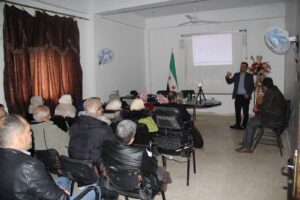
IhsanRD has organized field training seminars for farmers within the framework of the Inter-crops Project, with the aim of increasing practical experience in applying the best agricultural practices in the service of legumes and olive trees. The training covers practically all topics related to modern methods of agriculture, the use of machinery, planting dates, fertilization, disease control and modern irrigation techniques. Haj Abu Saleh, who was present at the symposium, spoke of the motivation for his presence: ” We may wait for the food basket aid, or we may plant what we really need by our hands. For me, I prefer eating from what I plant myself. When farmer the gives the best effort to his land and by the right agricultural practices, it will give him in return a better crop.”
This training seminars come after the project team successfully completed the previous stages, which included the first phase of registration of farmers in the project lists, and then conducting field inspection and standard testing of the quality of seeds and fertilizers before distributing them to farmers. Then spraying of fertilizers and sowing seeds that were previously distributed to farmers under the supervision of technical engineers and taking standard measurements according to modern methods of tillage and sowing.
[widgets_on_pages id=”widget demo”]
Have you ever met a Syrian citizen?
Oxford Definition: ̶a̶ ̶n̶a̶t̶i̶v̶e̶ ̶o̶r̶ ̶i̶n̶h̶a̶b̶i̶t̶a̶n̶t̶ ̶o̶f̶ ̶S̶y̶r̶i̶a̶,̶ ̶o̶r̶ ̶a̶ ̶p̶e̶r̶s̶o̶n̶ ̶o̶f̶ ̶S̶y̶r̶i̶a̶n̶ ̶d̶e̶s̶c̶e̶n̶t̶.
Real Definition: a person who crafts materials into brilliant sculptures under bombardment and siege; with fewer rights and too many let-downs on the international level.
Providing aid is not the only way to support the Syrians’ resilience, however, they prefer to enable their youth to build projects that serve their communities. A decent loaf of bread is the fruit produced out from work and cooperation.
See below: how IhsanRD has invested 250 workers in the “Cash-for-Work” project to rehabilitate the automated bakery in Al-Rastan – Northern Homs countryside.
[widgets_on_pages id=”widget demo”]
Gaziantep, February 14, 2018
From our collective moral responsibility to the Syrian people in need, the Syrian Humanitarian Non-Governmental Organizations calls on the government in Damascus, and its supporters, to grant humanitarian access to those in need, and to stop targeting civilians and civilian infrastructure in eastern Ghouta. The Syrian NGOs also calls on United Nations agencies and their representatives and the Security Council member states to fulfill their responsibility to protect civilians caught in the conflict, implement effective and immediate measures to end the suffering, and to break a siege being used as an illegal war tactic on innocent civilians.
For four years and four months, the Syrian regime has imposed a brutal siege on the people in eastern Ghouta, denying access to goods and humanitarian assistance to and from the area. The limited quantities allowed sporadically is not nearly enough to relieve the suffering of the large number of civilians trapped inside. Desperately needed medical equipment and supplies are regularly taken out of humanitarian convoys before being allowed to enter the besieged area.
In rare cases, limited quantities of commercial goods are allowed to enter the besieged enclave. However, due to the extremely high fees imposed on goods, people in the besieged area are unable to afford the bare minimum they desperately need. Those same fees are then used to continue funding the war, and maintaining the siege. In addition to suffering and starvation, some 400,000 people are constantly subjected to systematic air raids and missiles targeting civilian infrastructure such as hospitals, schools and markets.
The continuous and systematic targeting of innocent civilians and intentional starvation are a crime against humanity and must be recognized as such. The international community and the Security Council keep turning a blind eye on the atrocities in eastern Ghouta, and have proven incapable of stopping these war crimes. The people of eastern Ghouta have been abandoned by the world, and crimes against them remain unrecognized. By refusing to acknowledge offences committed against the people of Eastern Ghouta, United Nations agencies and human rights institutions fail the very purpose of their mandate.
On February 6, 2018, the United Nations Syria-based team issued a press statement calling a one month cessation of hostilities to enable delivery of humanitarian aid and services to people in need. In a clear contradiction in the very same statement, UN stated that reach to besieged areas is paralyzed due to access restrictions imposed and that if access was granted UN could reach over 700,000 people in besieged and hard to reach areas in two months. While it’s recognized the importance of a cessation in hostilities to protect civilians and alleviate their suffering, giving the impression that continuous civilian war in Syria is the main cause for lacking humanitarian access indicates great improper approach to address the issue. It’s shameful to keep avoid naming the major party who is behind the suffer of civilians and the crime against humanity being committed against them.
Despite seven years of conflict, humanitarian access in Syria was never completely blocked, except for areas deliberately besieged by parties to the conflict. The significant decrease in hostilities during the implementation of the de-escalation zones agreement in second half of 2017 in eastern Ghouta had no real impact on the humanitarian access to eastern Ghouta according to United Nations figures. Calling on a savage war that is continuous since more than seven years to pause to gain humanitarian access is an inacceptable approach and brings great diversion to realities and the main reasons behind people suffer.
The siege on eastern Ghouta is considered the longest in modern times. In 2016, eastern Aleppo’s besiegement lasted for six months, and despite the moderate deterioration in humanitarian situation for civilians, the siege ended with the retreat of non-governmental armed groups and the forced displacement of civilians to other areas.
The siege on eastern Ghouta has lasted for over four years now. While fighting around it is continuous since then, besieged civilians are being punished by hunger, sickness and constant death resulting from shelling and airstrikes. It is time for UN and member states to act immediately to put an end to this crime against humanity. It is time that Syrian regime in Damascus understands that battels are won at frontlines not through children and mothers hungriness, or by wounds and sickness of elderlies and the most vulnerable.
The targeting of civilians by all parties in Syria is unacceptable, must be stopped immediately, and perpetrators must be held accountable whoever they are. We are also shocked by the news from Damascus city indicating few civilians were killed by bombardment from Ghouta direction. We condemn these acts and call on putting them to an end.
For further information, please contact:
Khaled Mosafa, Syrian NGO Alliance Advocacy and Communication Coordinator: Advocacy@Syrianna.org, +905316929229.
Mohammed Alhammadi, Syria NGO Alliance Coordinator: Coordinator@Syrianna.org. +905383685851
[widgets_on_pages id=”widget demo”]
Rida, a young graduate from the Youth Support Center, supported by IhsanRD in Al-Rastan, Homs countryside.
“I dreamed of having my own barbershop, so I joined the haircut course that was held at the Youth Support Center” Rida said.
Today, Rida’s dream has become true by opening (Rida’s Barbershop), he would be happy to welcome you in his salon.
Those active young people, such as “Rida” are the examples through-which IhsanRD feels proud.
[widgets_on_pages id=”widget demo”]


العربية
Turkish